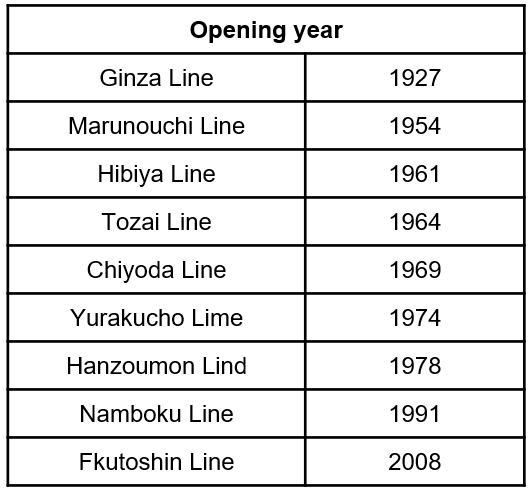
The history of the Tokyo Metro Group began with the founding of its predecessor, the Tokyo Underground Railway Company in 1920. Based on founder Noritsugu Hayakawa's belief that a subway was essential for Tokyo's development, in 1927 the company opened the first subway in Asia. In 1941, Teito Rapid Transit Authority was established and supported Tokyo's growth through expansion of the subway network.
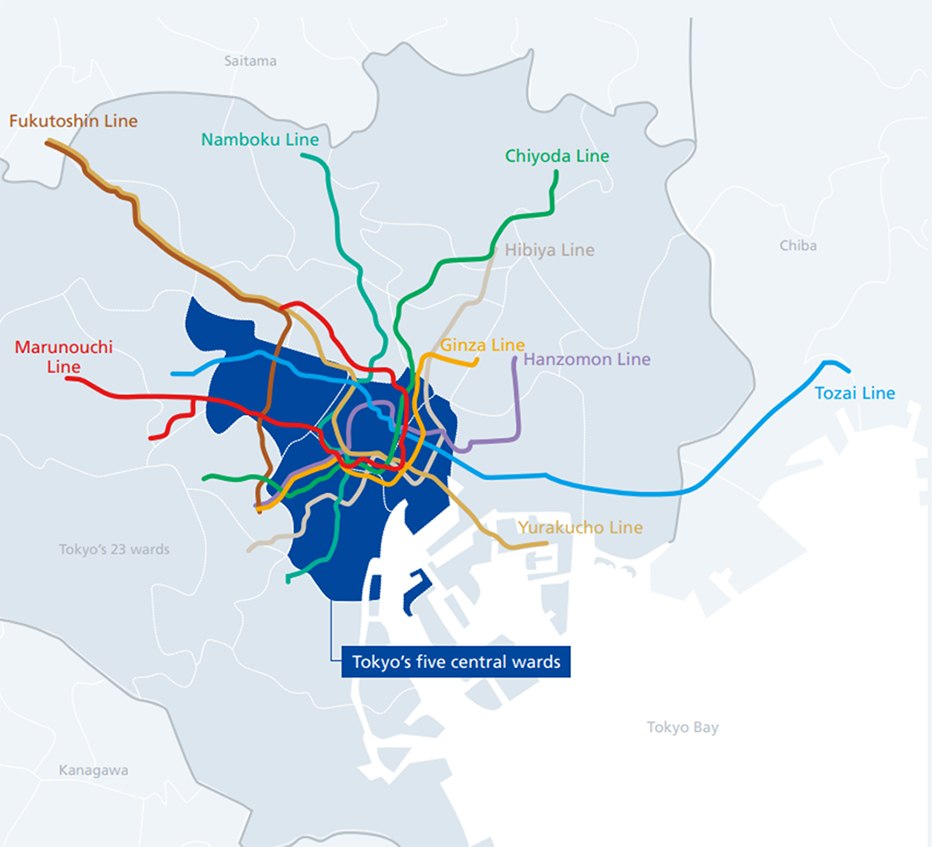
The 2004 establishment of Tokyo Metro Co., Ltd. marked a new beginning. Today, Tokyo Metro operates one of the largest railway networks in the Greater Tokyo Area, with nine lines covering 195.0 operating kilometers and linking 180 stations, primarily in the 23 wards of Tokyo. With the safety of customers as our first priority, we have focused on the unremitting pursuit of safety and the further enhancement of high-quality, customer-oriented services. Further, in 2020 we began implementing measures to ensure the sustainability of our businesses and heighten corporate value in an unprecedentedly different management environment. Our measures included reforming cost structures with a view to advancing Structural Reform for the post-COVID-19 era and seeking New Breakthroughs. In 2024, the company was listed on of the Tokyo Stock Exchange Prime Market. To further drive reform and growth, we will advance various types of measures based on the Mid-Term Management Plan.
Main topics
1927: Opening of the First Subway in Asia
Tokyo urgently needed a subway to improve a congested transportation network and enable the city's further development. Accordingly, a 2.2-kilometer line between Asakusa and Ueno was opened, becoming the first subway in Asia.
1950s and 1960s: Expanding Our Network in Tandem with Rapid Economic Growth
Around the time of the Marunouchi Line's opening in 1954, the spread of electric domestic appliances such as televisions, refrigerators, and washing machines spurred the emergence of a new lifestyle in Japan. Together with this modern lifestyle, the subway contributed to the country's postwar recovery. During the 1960s, new subways were constructed in the city at a pace of about six kilometers per year, with, the Hibiya Line opening fully in time for the Tokyo Olympics in 1964. To meet rapidly increasing demand from commuters, the Tozai and Chiyoda lines were also launched successively.
1970s and 1980s: Introducing Environment-Friendly,Energy-Efficient
As it opened new lines and extended existing lines, the company actively incorporated the latest technologies. In 1971, it improved the energy performance of train cars by introducing Series 6000 train cars, the world's first energy-efficient train cars combining chopper controllers and regenerative braking systems, to the Chiyoda Line.
1990s: Becoming Japan's First Subway System with Platform Doors
From its opening in 1991, all stations on the Namboku Line included platform doors. As well as making platforms safer, we created a user-friendly subway and actively developed barrier-free accessibility through measures such as the installation of elevators. In this way, we pioneered the current drive to establish barrier-free facilities.
2000s: Embarking on a New Journey as Tokyo Metro
From its opening in 1991, all stations on the Namboku Line included platform doors. As well as making platforms safer, we created a user-friendly subway and actively developed barrier-free accessibility through measures such as the installation of elevators. In this way, we pioneered the current drive to establish barrier-free facilities.
2010s: Advancing Natural Disaster Countermeasures and Barrier-Free Accessibility
With the aim of responding to the increasing severity of natural disasters and supporting Tokyo's urban functions, we have strengthened our natural disaster preparedness by advancing countermeasures for earthquakes and major floods. Further, to fulfill our social responsibility as a transportation operator, we brought forward the establishment of barrier-free facilities.
2020∼2023: Advancing Structural Reform for the Post-COVID-19 Era and Seeking New Breakthroughs
To enhance business sustainability and corporate value in a new operating environment, the Group fundamentally reformed its cost structure, undertook new line construction, created travel demand, and strengthened the Urban Design and Lifestyle Creation Business.
2024∼ : Achieving Stock Listing and Pursuing Initiatives for Further Growth
Tokyo Metro will use the listing of its stock as an opportunity to drive change and growth. As part of these efforts, we will further improve railway safety and services, including natural disaster preparedness and barrier-free accessibility, and steadily construct new railway lines. In addition, we will develop and promote new technologies such as automated train operation technology, generate demand for railways, create new businesses, and expand the Urban Design and Lifestyle Creation Business, including the Real Estate Business, which also contributes to urban development and railway growth
Strengths
Business Area in the Heart of Tokyo
Tokyo Metro's service area is Tokyo—Japan's political, economic, and financial hub. As one of the largest metropolitan areas in the world, Tokyo attracts people not only from across Japan but also from around the world, offering the Tokyo Metro Group a vast array of business opportunities.
Tokyo's Potential
Tokyo, which is the Tokyo Metro Group's business foundation, is one of the world's leading political, economic, and cultural centers, and its nighttime population is expected to increase steadily until 2045. In addition, many new office buildings are being developed in the city. Moreover, since most of this development is concentrated in the five central wards, where we have lines, we expect an increase in the flow of people through these areas.
Also, the number of visitors to Japan is at an all-time high, and the number of non-Japanese Tokyo residents continues to grow. Further increases in visitors to Japan are likely as the government pursues the goal of receiving 60 million visitors a year to Japan by 2030.
In the city, the construction of numerous large complexes is planned primarily in areas along our railway lines. The advancement of these development initiatives promises to boost the flow of people in areas along our railway lines.
Further Bolstering Our Strengths
To ensure that further exploitation of Tokyo's potential leads to Tokyo Metro's growth, the company will advance measures aimed at creating mobility opportunities.
Specifically, the company will advance measures for visitors to Japan by strengthening sales of special tickets, such as the Tokyo City Pass package product, which combines a Tokyo Subway Ticket and a tourism ticket and gives access to Tokyo's main tourism facilities, and by developing new products; roll out boarding services based on contactless credit card payment and QR Code tickets;* and move forward with digital marketing that utilizes points of contact with customers, primarily the Metro Point Club app and the Tokyo Metro My! app.
In addition, the Tokyo Metro Group will create new value by promoting real estate development and large-scale redevelopment that utilize acquired and owned real estate directly connected to or near stations.
QR Code is a registered trademark of DENSO WAVE INCORPORATED in Japan and in other countries.
The Core of the Metropolitan Railway Network
The Greater Tokyo area is comprehensively interconnected by a railway network comprising subways, JR East railway lines, and private railway lines. Beginning from downtown Tokyo, these lines extend to suburbs in the north, south, east, and west of the metropolitan area. Railway operators not only provide railways as a means of transportation but also build homes near stations and develop commercial facilities at hub stations, thereby enhancing the appeal of areas along their railway lines. As a result, the Tokyo Area has attracted a population of approximately 36 million people and become one of the world's largest conurbations.
Collaboration with Other Companies
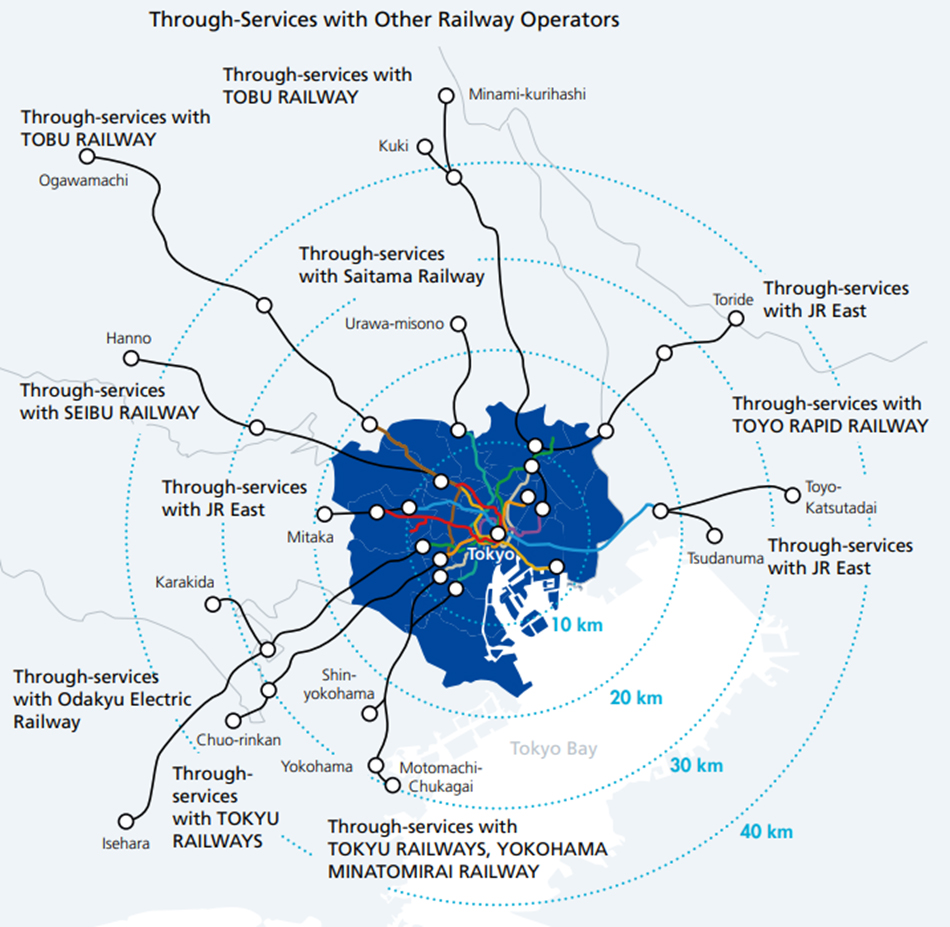
Our railway network has a total route length of 556.6 kilometers, including the lines of the many other railway companies with whom we operate through-services. At the center of this extended network is Tokyo Metro's subway network in downtown Tokyo, the hub of Japan's political, economic, and cultural activities.
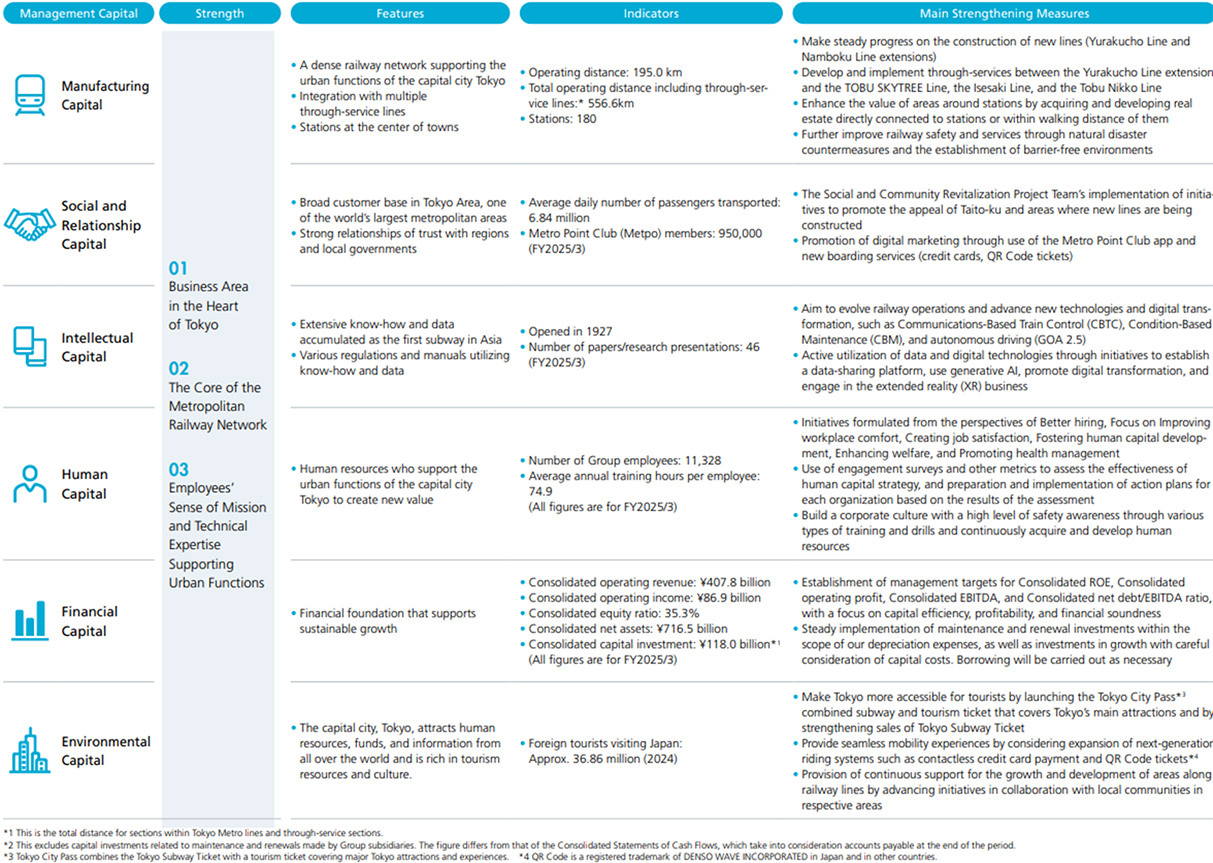
We operate a subway system that comprises nine lines and 180 stations, covers 195.0 operating kilometers, and primarily serves the 23 wards of Tokyo. Of these lines, seven have through-services with other railway operators. Our extensive network is an important part of the Greater Tokyo Area's transportation infrastructure. The network supports day-to-day life and business activities by providing seamless transportation services throughout the Tokyo area, from the outskirts of the city to its center. Further, we are implementing various measures to provide services that cater to day-trippers as well as the needs of visitors to Japan and other tourists in Tokyo. Carrying an average of 6.84 million passengers each day, our system plays a central role as the core of the metropolitan railway network.
Further Bolstering Our Strengths
With a view to beginning operations in the mid-2030s, Tokyo Metro is working to extend the Yurakucho Line from Toyosu to Sumiyoshi and the Namboku Line from Shinagawa to Shirokanetakanawa. These initiatives are premised on the receipt of sufficient subsidies and other funding in accordance with the Council for Transport Policy Report No. 371 and agreements with the national government and the Tokyo Metropolitan Government.
In particular, with respect to our extension of the Yurakucho Line, we aim to realize through-services with the TOBU SKYTREE Line, the Isesaki Line, and the Tobu Nikko Line. By strengthening the railway network, we will improve accessibility to the waterfront and downtown areas, contribute to urban development in areas along railway lines, help strengthen Tokyo's global competitiveness, and create new demand for railways.
Additionally, by eliminating delays on existing lines through measures such as improvement of the Tozai Line's transportation capacity and an increase in Communications-Based Train Control (CBTC) lines and by implementing countermeasures for increasingly severe natural disasters, including earthquake preparedness and large-scale flood prevention, and enhancing security, we will provide safe, reliable railway services that reflect changes in customer usage trends and social conditions.
Employees' Sense of Mission and Technical Expertise Supporting Urban Functions
As a transportation provider supporting the capital city, the Tokyo Metro Group views ensuring transportation safety as a mission that takes precedence over all else.
Accordingly, the Group has established comprehensive preparedness capabilities. As well as putting in place a variety of equipment and facilities to enable safety and disaster prevention measures that underpin the reliability of transportation in a unique underground environment, we regularly conduct a variety of training aimed at ensuring customer safety and employees' acquisition of the skills needed to expedite the restoration of transportation services in the event of accidents or disasters.
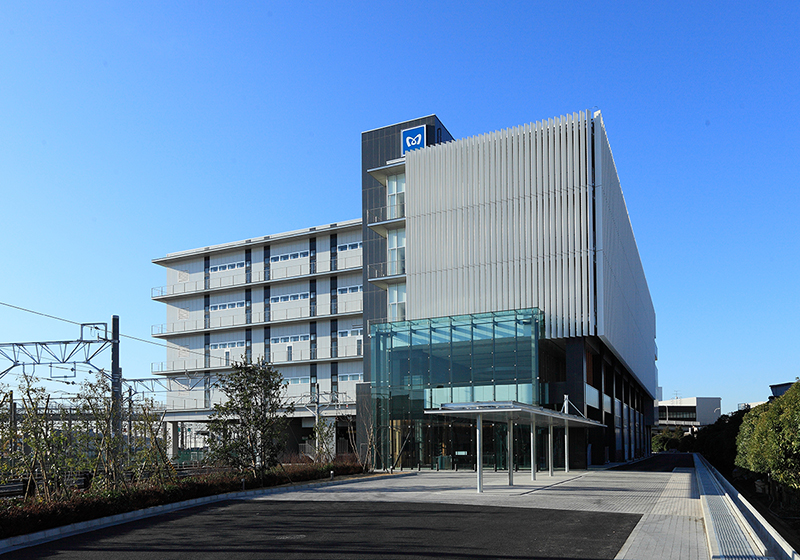
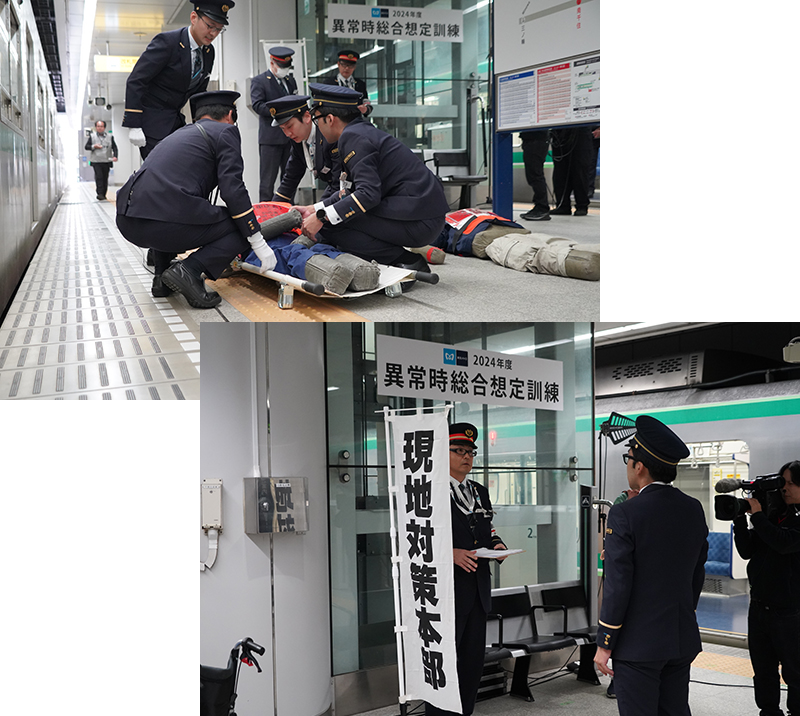
The Comprehensive Learning and Training CenterA Comprehensive emergency simulation drill
Skills That Provide Additional Reassurance
The Tokyo Metro Group has operated public transportation in Japan's capital city Tokyo for approximately 100 years. During this time, we have developed a comprehensive range of technologies and expertise to ensure safe, reliable transportation in a unique underground environment. Through training and drills, we foster personnel equipped with the knowledge and skills needed to further enhance these strengths and to continue to ensure the safety of all customers and provide them with reassurance.
The Group enhances its overall capabilities by conducting a range of different initiatives for personnel development at the Comprehensive Learning and Training Center, established in April 2016. Training themed on always being ready, never fearing failure, and real-world scenarios improves knowledge and skills that foster cooperation and promotes interdepartmental collaboration.
Every fall, officers, employees, and customer monitors, who play the role of customers, participate in a comprehensive emergency simulation drill, delivering practical training based on accident and disaster scenarios at the training center. In addition, we actively participate in joint training sessions organized by municipal authorities and by police and fire departments.
Further Bolstering Our Strengths
The Tokyo Metro Group conducts safety training at the Safety Consciousness Development Center for all officers and employees of the Group, thereby continuing to form a corporate culture that gives first priority to safety. In addition to continuing to conduct training and drills at the Comprehensive Learning and Training Center, we will implement training that encourages employees to think for themselves, take on challenges, and collaborate, including training in safety, compliance, and business English training. To further promote the use of digital technologies and data analysis, we will step up efforts to develop personnel with digital technology skills.
The Group will also advance various initiatives formulated from the perspectives of Better hiring, Focus on improving workplace comfort, Creating job satisfaction, Fostering human capital development, Enhancing welfare, and Promoting health management.
Management Capital
Value Creation Process
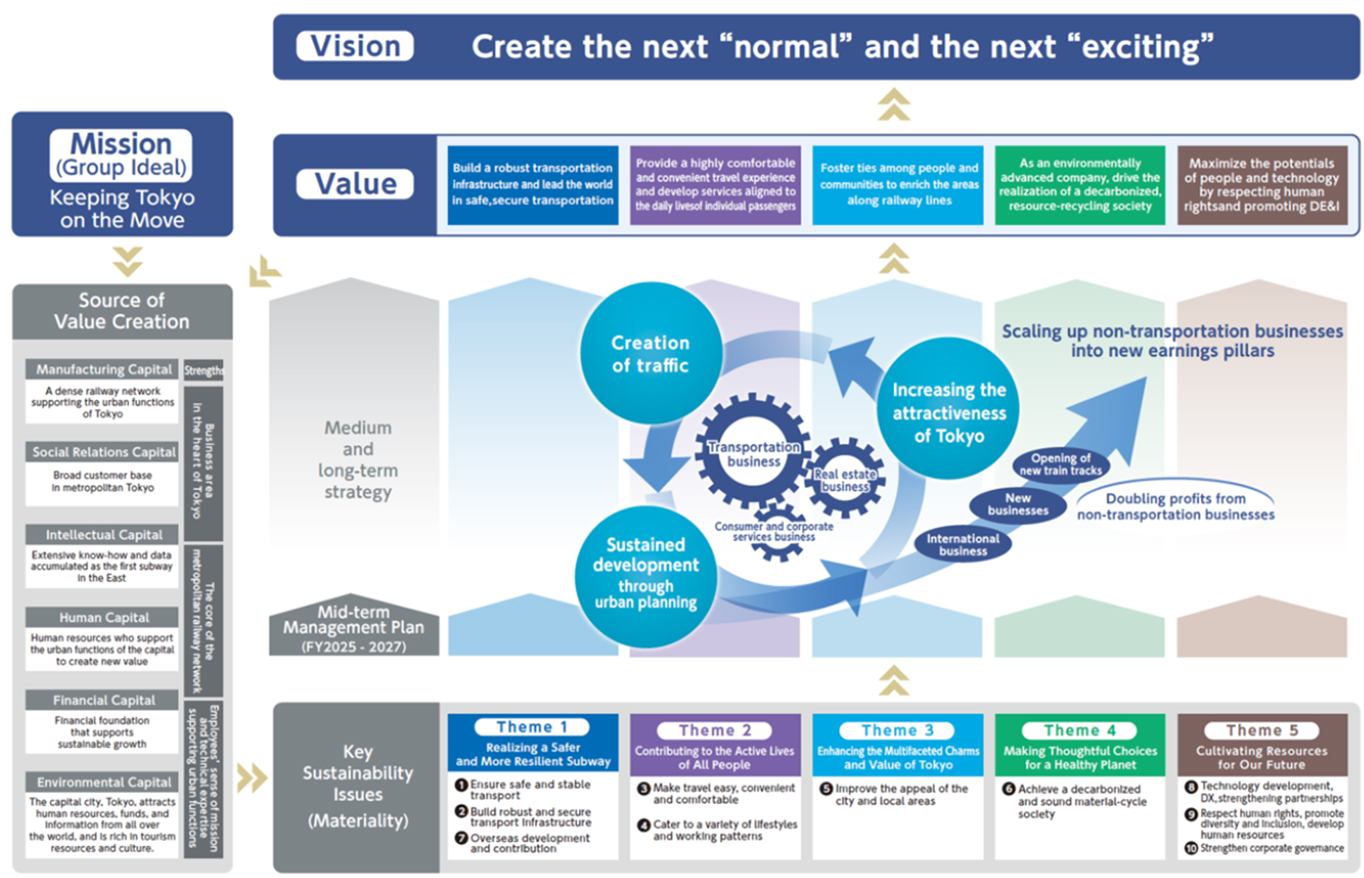
The Tokyo Metro Group aims to create a virtuous cycle and achieve its vision by strengthening synergy across the Real Estate Business and the Consumer and the Corporate Services Business, mainly with the Transportation Business based on its three strengths: a Business Area in the Heart of Tokyo, being at The Core of the Metropolitan Railway Network, and Employees' Sense of Mission and Technical Expertise Supporting Urban Functions.
Vision : Create the Next "Normal" and the Next "Exciting"
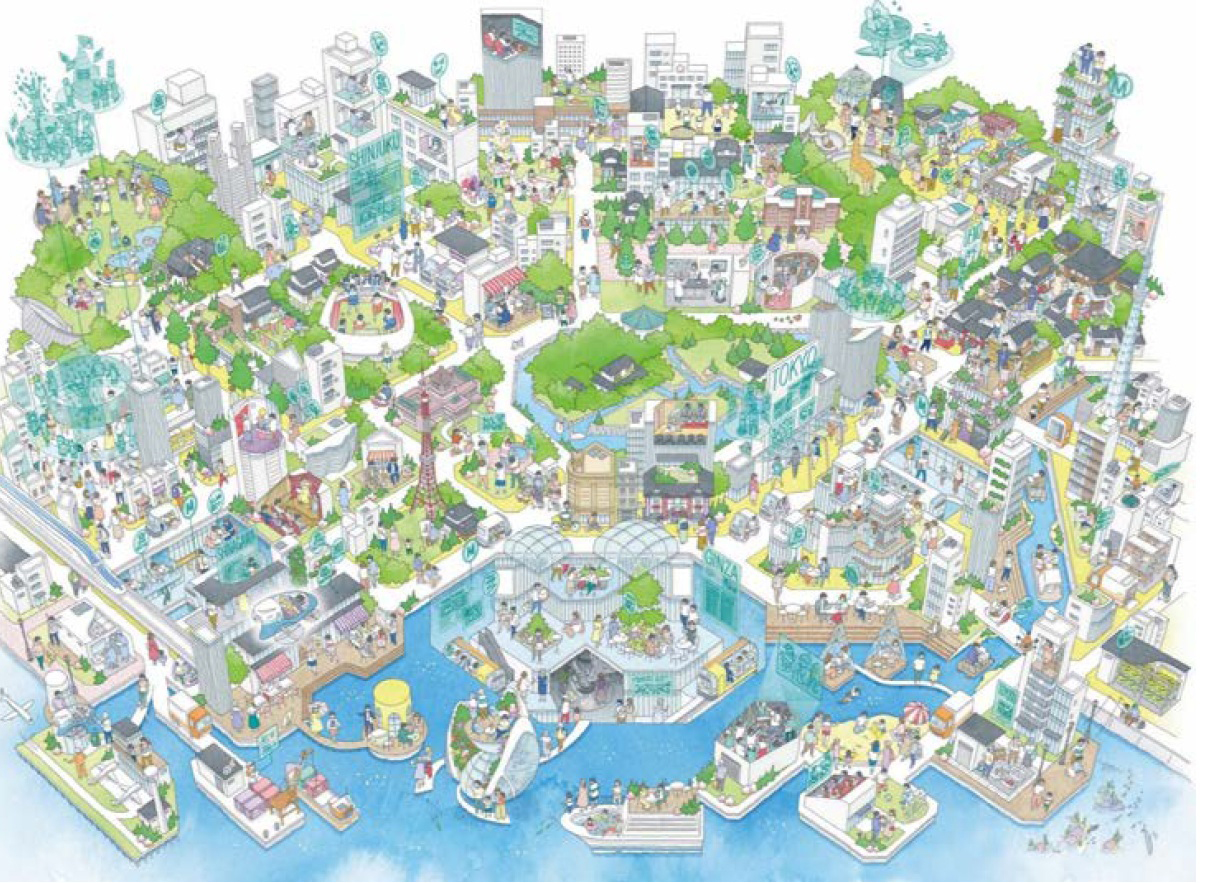
We aim for a future in which everyone can experience well-being by creating real experiences and opportunities tailored to each individual, while supporting safe and secure daily life.
Create the Next "Normal" : The things we consider "normal" change and progress day in and day out. Tokyo Metro Group's business is likewise constantly evolving as it leads the way to the new normal.
Create the Next "Exciting" : We will build a future that is inspirational to all by providing new travel experiences and co-creating with local communities, governments, developers, and other partners.
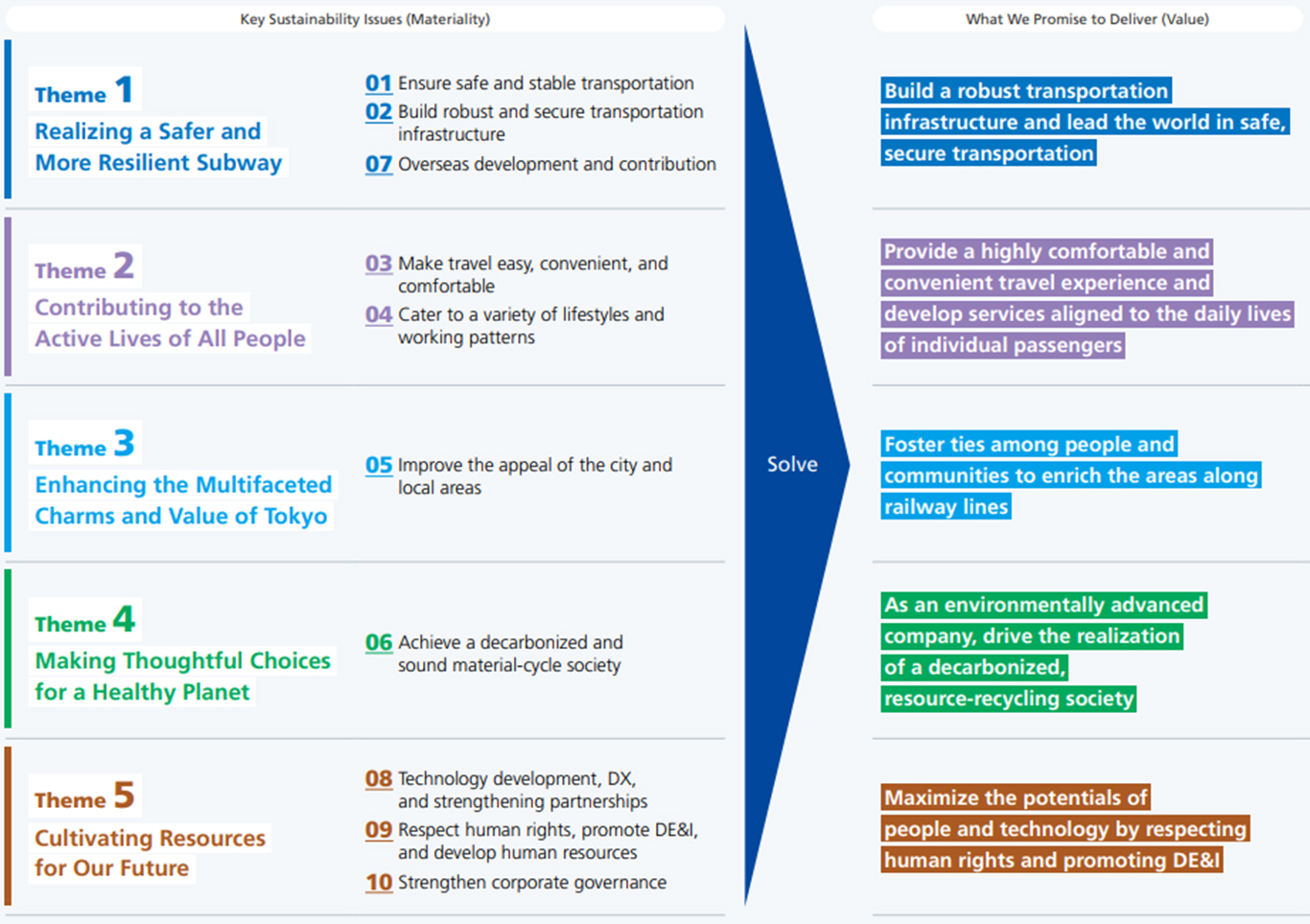
Value (What We Promise to Deliver to Stakeholders)
By addressing our key sustainability issues (materiality), the Tokyo Metro Group promises to provide value, which we define as shown below.
For information on Key Sustainability Issues (Materiality), please refer to the following page.